16 (edited by lyra 2005-03-17 09:34:26)

Re: My story: Caught in the web!

And another internet story.....Here at the hotel, some woman was using the computer room to take care of her OOH!  IMPORTANT!!! email, and she's got a SCREAMING, wailing, hysterical toddler.  The kid's going ballistic, but she's so engrossed and entranced by the computer / internet that she's tuning him out.  I had to go in and help reboot the computer during all of this, and while I was in there, the kid....takes off.  Bolts for the door.   Takes of streaking down the hall, straight for the stairway!    I was like AHHH!  and go chasing him down.   Let me tell you....kids are QUICK!!    He made me run!! big_smile    Who knew?  Future track star!  big_smile  So I'm bolting after him, the GM of the entire hotel is watching like, "AHH!  THE STAIRS!  NO!!"  and what is the mom doing in the meantime?

She's glued to the internet.   Completely absorbed.   Her back turned to us, could care less.   Then FINALLY she gets a clue, tears herself away for 5 seconds from her precious email and internet to come see what's going on.  She doesn't run either, she's more like "ugggh??  something is happening??  duh??   ughhh?"  I give her an alarmed look, like, "HEY woman, take care of your kid why don't you.  Be a mom, do your job."   I just couldn't believe it.   It was worse then it sounds actually, words don't convey the situation accurately.

So then what does she do?   Brings the kid back into the computer room, door closed, and it's back on her precious internet while the kid is absolutley SCREAMING and wailing away again, despite the fact there was somebody else in the room too.   She didn't care.   She was SOOO engrossed by the 'net.   And this goes on.....for about 15 minutes.  She completely ignores him and tunes him out while she's glued to her precious internet.   I heard her saying, "Just one email baby....just one email......"

Oh jeez.  SMACK!   

The wonders of the internet.....  wink

"Life's journey is not to arrive at the grave safely in a well preserved body, but rather to skid in sideways, totally worn out, shouting "Holy shit ... what a ride!"  - Anonymous
-----
"I get by with a little help from my (higher density) friends."
-----

17

Re: My story: Caught in the web!

Lyra,

Sounds similar to what I observed at a cybercafe I used to frequent:

A women came in with a young (2 or 3 year old) son and sat down at a computer to use the internet. The kid was obviously upset, and started crying. She actually started swearing and going ballistic at the kid right in front of everyone... this continued for about 10 minutes until she actually started to hit him quite hard, his obvious reaction being to scream even louder. It was at this point that just about every other person in this place, including myself, started to say to think "this lady's nuts, and she's making far more noise than her kid is"... So everyone started letting her know: "be nice to your kid" or "leave him alone, he's just a kid"... until someone yelled to her:
"Lady, what the f*ck are you doing bringing a kid that young to a place like this?!?" upon which she got up, swore at us all a few times and stormed out without paying.

Re: My story: Caught in the web!

Not much more I can add to this topic, except this: the percentage of truthseekers receptive to learning and networking is miniscule among the general population. Your success of interacting with them in the "real world" depends on being in the right place at the right time, on the type of community you interact with and how extensively you interact with others. If the percentage is around 1%, then by chance you'll make one connection for every hundred "ordinary" people you deal with. My point is that despite its trade-offs, the internet as a portal opens up a sample base of millions upon millions of people, and so it's far easier searching and finding resonant people.

But only as long as means are not confused with ends...maybe that's where the problem is -- the internet as a substitute for reality, or a means by which real world progress can be catalyzed. For example, internet relationships vs internet connections that lead to real relationships. Same for networking. Get rid of computers and internet? Only if they have served their purpose, or if other means can create the same ends. For instance: 1) if your network begins on the internet but eventually becomes entirely real-world based then you may not need the 'net' to catch more 'fish' or 2) if you live in an unusually open minded area where you can make connections at local hangout spots.

My intuition says that by the time the internet disappears, it will have served its purpose for those who made good use of it, and that by then other better means may be available. The timing will be perfect and in accordance with destiny. Soloflecks said, "But in the long run ermolai's correct, because the day is coming when we won't be able to rely on technology." -- absolutely, but this implies several things. First, that we better use it while it's still here if it serves a purpose. Second, that its purpose may be to more efficiently set up that which supercedes and survives technology (networking, lessons). And third, that everything comes at its proper time and getting the timing mixed up defeats its purpose. One day we'll all stop breathing, but rather than hold our breath now to prepare we can use our breath to stay alive and spiritually prepare for that which supercedes death.

But for the moment, it's also a matter of balance - and what brings you toward balance varies from individual to individual. If you hyperventilate, hold your breath...if you are suffocating, take a deep one. Ermolai's clearly overdosed and a return to balance would require complete detox from computers/internet. My own requirements for balance are not as severe, but I am streamlining my online activities and am prepping/practicing for taking some of these to the "real world" -- both are symbiotic in my experience, mutual catalysts that work best in tandem and balance.

Acquiring fringe knowledge is like digging for diamonds in a mine field.

Re: My story: Caught in the web!

I thought Daniel Pinchbeck's comments in the interview at http://www.newworlddisorder.ca/issuethr … hbeck.html are very relevant to this discussion and ties in closely with what Montalk just said about the internet serving a valuable purpose until a time comes when we can supercede it.

--

NWD: Many believe that the noosphere planetary mind is emerging with the rapid spread of information networks such as the internet and other linking technologies. But some philosophers - such as Heidegger and Evola, if memory serves - thought that reliance on technology to boost our capabilities is a sign of decadence, not evolution. What do you think the nature of the noosphere is, and does it have any relation to information technology?

DP: The esoteric perspective is that everything in the universe is conscious to a certain degree, and continually in the process of transforming to more or less intensified states of awareness. According to the Buddhists, the physical reality we experience is actually "maya," illusion or dream, and reality is constructed by subtle levels of the mind. I believe these principles to be correct. Therefore, technology, for me, is actually a projection of human consciousness into matter, materiality (a temporarily densified form of spirit). It is a phase in a process that may end with us reintegrating these unleashed back into consciousness at a more intensified level of development (what Gurdjieff would call a "higher octave."). Sri Auribindo called this future point the "supramental" state. The seemingly accelerating and self-assembling process of technological evolution, in other words, is required to move us from one level of dream to another one, and from one planetary incarnation to the next. It is clear that our technologies are rapidly dematerializing and becoming increasingly indistinguishable from telepathy - at the same time, many people, myself included, seem to be experiencing an almost exponential increase in synchronicities and other types of phenomena that suggest that the psychic and physical realms are approaching each other at a high speed.

So yes, it seems like the noosphere is being born, and the network technologies are one current manifestation of this process. It is possible that these technologies will no longer be necessary once we have made the transition. I think the "nature of the noosphere" will be this deeper collusion between the physical and the psychic, and we are already in the midst of the transition. I am very excited about what lies just ahead of us. I expect the noosphere to be highly sexy and to have a great dance beat.

Join me in Peru to celebrate December 21st 2012 - Visit: http://2012awakeningretreat.com/

Re: My story: Caught in the web!

Interesting posts, not a lot to add really.  But I would like to ask a question of ermolai; what do you mean by "Luciferic Technology"?  I am assuming you using the reference Luciferic in the same manner Steiner does.  But how would / does this apply to the use of technology?

Cheers...

Re: My story: Caught in the web!

I'm refering to occult technologies which manipulate astral energies. Almost all New Age "spiritual tools" fit in this category.

22

Re: My story: Caught in the web!

What happens when the inmense majority of people that i meet physically is boring, that very very rarely i found one to talk of rare matters like those discussed in this forum.

Demonization of technology like internet is not te soution to your inner problems.


Human being, the human of all presents i know and knew, ENJOYS a lot being unresponsible of his own desperation. Ih, i have to say, that is so sad.

The MAIN problem is unacceptance os your own responsibility of power: your gratest problem is your grates power: your freedom.

Re: My story: Caught in the web!

Thanks for sharing your story, Ermolai.

On the subject of technology, an esoteric futurist might add, does 4D STO have "technology"?  Does technology continue to act separate from non-technology as awareness advances?  What is "technology" in the future?

24

Re: My story: Caught in the web!

Wynderer; u are not aware of the marelovus possibilities internet could offer to all of us, and are offering to us now. On simple example: you could read that thing i am wrinting here, and now. Your critics are useless and inadequate in my opinion. Demonization of anything is always horrible in shape. Salut.

25 (edited by lyra 2005-04-10 14:02:12)

Re: My story: Caught in the web!

Racsouran wrote:

Wynderer; u are not aware of the marelovus possibilities internet could offer to all of us, and are offering to us now. On simple example: you could read that thing i am wrinting here, and now. Your critics are useless and inadequate in my opinion. Demonization of anything is always horrible in shape. Salut.

Her critics are "useless" and "inadequate" ?   !  Oh my.   Well, I don't think so.  Her "critics" have a lot of value, and thanks for sharing them wynderer.  That was a great post. 

Racsouran, you might try re-reading what wynderer wrote, you might have missed what she was saying.  In fact I think you missed most of what she was saying.  She was sharing her personal story and experiences with technology....bad AND good.    Both.  Not just the negative.   Personally, I found wynderer's experience to be fascinating.  Again, thanks for sharing them wynderer.   smile

"Life's journey is not to arrive at the grave safely in a well preserved body, but rather to skid in sideways, totally worn out, shouting "Holy shit ... what a ride!"  - Anonymous
-----
"I get by with a little help from my (higher density) friends."
-----

26 (edited by Marcus 2005-04-11 03:28:13)

Re: My story: Caught in the web!

wynderer I know exactly what you mean.  I have a lot of trouble trying to communicate with people - mainly because I find the disconnected and superficial way of life very dull and uninteresting.  Like you I interact with people - and spend most of that time listening to what they have to say.  None really listen to anything I would have to say - whether it be superficial or not.  Not that I am the sort of person to talk about myself anyway.

This seems to be becoming an increasingly greater problem.  Over the past few years it seems things have actually gotten worse with people, as they are sucked into TV, Internet, Mobile Phone, constant non-stop sending of text messages (I actually joked to my niece once about the fact she never puts down her mobile phone.  I said that she needn't worry because one day implants will be developed so that she could be in permanent contact with everyone.  She actually thought this was a great idea).

And so all the conversations I can potentially have, revolve around soap operas, current mainstream news stories, fashion, boyfriends, and sex.  On and on and on…  And of course the non-stop constant inane chatter about work, work, work, work...

Makes me want to almost cry at times.

Of course if I venture out into other topics I am considered weird.

Fortunately I have two people – one who is really close – whereby the relationship is extremely deep and anything but superficial.

Now the Internet I have had in the home for since about 1997 – slowly it has gained a greater central focus in my life.  I see this also happening with other people and it is making them even more superficial (constantly looking for sounds bites, gossip and ringtones).  For me on the other hand it has become a place where I can connect with other people – share my thoughts and listen to their deep personal beliefs.

If the Internet does indeed disappear in its current useful form, then I really will despair.  For where else to turn in a society that is totally conditioned?

27 (edited by ermolai 2005-04-11 04:10:23)

Re: My story: Caught in the web!

wynderer wrote:

I also think that in one sense the Net is a precursor of global telepathy.

No doubt about it, but please ask yourself if global telepathy (a.k.a. Teilhard de Chardin's noosphere) is positive for human spirit and freewill. This subject is so big that I could almost write a book about it. To feed your thoughts, here are some quotes that I found this weekend, linking LSD, the Internet, the noosphere and nano/biotechnology (odd connections, right?).

Science-fiction novels exploring the mutant theme, like Theodore Sturgeon's More than Human (1953) and Robert Heinlein's Crowley-influenced bestseller Stranger in a Strange Land (1961) became cult favourites in the sixities. Along with Childhood's End, More than Human was central influence on the ideas of Ken Kesey, leader of the LSD-fuelled Merry Pranksters and originator of the famous Trips Festivals that got the San Francisco acid-rock scene going.

In 1964, after their first run across the States in their famous psychedelic bus, the Pranksters began to feel the effects of their daily diet of LSD. They felt they were acquiring strange powers, and developing a group mind, like the children in Village of the Damned. Neal Cassady, the model for Dean Moriatry in Jack Kerouak's influential novel On the Road, was the Pranksters' driver. He discovered he could turn his attention to several things at once -- a power that often frightened uninitiates in the passenger seat. Kesey seemed to be able to read minds.

As other alternative groups in the sixties would experience, a weird gestalt began to evolve among the Pranksters: they began to feel their separate psyches were fusing into a single collective consciousness with superhuman powers: telepathy, psychokinesis, precognition. With Teilhard de Chardin, they began to believe that "Nothing in the universe can resist the cumulative ardour of a sufficiently large number of enlightened minds working togther in organized groups".

Extract from TURN OFF YOUR MIND
The mystic sixties and the dark side of the Age of Aquarius
by Gary Lachman

In the TNT docudrama Pirates of Silicon Valley (1999), Apple founder Steve Jobs is depicted on an acid trip in which he conceives himself the conductor of his own cosmic symphony. Bob Wallace, one of the early developers of Microsoft, who now runs Mind Books, the online purveyor of tomes devoted to psychedelic and alternative consciousness, has said that his conception of shareware as a formal business application was psychedelically inspired. Lotus spreadsheet designer Mitchell Kapor, co-founder with Grateful Dead lyricist John Perry Barlow of the Electronic Frontier Foundation, an Internet advocacy organization, has attributed certain “recreational chemicals�  with sharpening his business acumen. Bob Jesse left his position as vice president of business development at Oracle, the world’s second largest software company after Microsoft, to head the Council on Spiritual Practices, a non-profit organization that advocates (among other things) the responsible use of entheogens (divine-manifesting drugs) for religious purposes. Such a marriage of technology and psychedelic consciousness – and a resoundingly profitable and influential one at that -- might have been foretold by Marshall McLuhan’s 1968 observation that "the computer is the LSD of the business world."

http://psychedelicadventures.com/BriefHistory.htm

This process culminates into a global or universal unanimity of minds, with an intense global interaction, but without losing their indivuality, and thus conserving the ability to stay aware of, and to consciously control reality, each individual at the highest possible intellectual level. Of course, devices from Internet to direct computer-to-brain connections will significantly enhance this ability.

[...]

The Global Brain hypothesis is a "hardware" hypothesis, describing the ultimate integration of all human minds, probably combined with powerful computers, forming together one hyper-brain, functioning on a higher level than each separate brain, like then human brain functions on a higher level than each separate nerve cell. As nerve cells don't get a global image of the brain activities, ultimately the individual human brains will no longer hold a global impression of the intellectual activities of the Global Brain [!!!!!!!!!!!]. A comparison can be made with company employees (or soldiers, or spies), each working on some limited aspect of a big project, and just transmitting their results to a board of directors, who assemble the details and are the ones to oversee the whole operation.

[...]

We could compare it with a computer programme that can be personalised by each user, making macro's and adding higher definitions. Some creative people elaborate new "routines", that progressively are "copied" by other people, and become ultimately a part of the "updated" culture. As happened with the host of totally different word processors that existed since the 80s and progressively converged ("integrated") towards two or three programs with little or no differences, we can expect that the different psychological ways of functioning, by interaction and mutual inspiration during education and each form of social contact, will progressively converge to one polyvalent, but fundamentally identical "psychological software" used by all men, each adding some personal flavours and nuances.

http://noosphere.cc/globalmind.html

Many people know Timothy Leary as drug-guru of the psychedelic counterculture of the 1960s. Not so many people know, however, that Leary reemerged in the eighties as energetic promoter of the Internet and spokesman of the Cyberpunks, an Information-Age counterculture whose members believe that technology can help us to free ourselves from all limits - physical as well as metaphysical. In this paper, I describe the development of Leary's theories - how his focus shifted from psychedelic drugs to computers -, and discuss Leary's impact on the cybernetic counterculture (the Cyberpunks) of the eighties and nineties. I compare Leary's earlier theories, in which he praises LSD as key to "cosmic consciousness" and sweeping societal changes, to his later theories, in which he describes the computer as tool of liberation and transcendence. In a critical analysis of the cybernetic counterculture I try to find out what role Leary played in this counterculture. My comparison of Leary's earlier and later theories shows that the psychedelic counterculture of the sixties and the cybernetic counterculture of the eighties and nineties have many things in common; most important of all, they share the same aim: Individual freedom and ecstasy. I argue that the cyber-movement of the eighties and nineties is a continuation of the freedom revolution of the sixties counterculture. For Leary, the emergence of a global electronic cybernetic communication network is a logical consequence (or further development) of psychedelic consciousness-expansion. In my analysis of the cybernetic counterculture I come to the conclusion that Leary was one of the founding fathers of the cyber-movement and therefore plays a central role in the cybernetic counterculture.

http://www.geocities.com/arno_3/

During his later days, he [Leary] didn't talk about it [the Eight Circuit model] much. I think as he embraced "chaos", he wanted to distance himself from the tidiness of the model. After all, did any of us live perfect, smooth, Circuit-Six, psychedelic, yogic lives? Or did we not, occasionally, get drunk[...] But when I think about it, I'm impressed, particularly with how the evolution of the technoculture since the 1970s matches his predictions of future evolution. In a clear gelatin capsule: Circuit Six, the neuroelectric circuit, is already a pop culture phenomenon, otherwise known as cyberculture, wired, the Web, the Net, cyberspace, etc. The notion of living in electricity is with us. More important, it surprised our culture by preceding Circuit Seven, the neurogenetic circuit - biotechnology as a popular phenomenon, which is just slowly coming into its own. When you hear about garage gene hacking, you'll know we've arrived. And who would have guessed that nanotechnology mainman Eric Drexler would come along and begin mapping Circuit Eight, the neuroatomic level, human empowerment on the molecular/atomic level?

http://www.geocities.com/arno_3/3/3-5.html

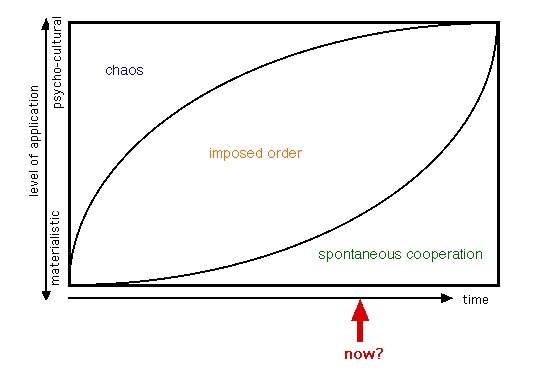
This image sums up their whole plan regarding the noosphere:

http://noosphere.cc/socTrend.jpg

In this scheme, the x represents the progress of time, and y the level at which transitions occur: from simple, materialistic aspects of daily life, e.g. respecting the rules of traffic, towards high psychocultural concerns, e.g. searching together to find the secret of happiness in a long lasting love. This graph illustrates two tendencies:

(1) in the beginning human co-operation and social interaction is rather absent. There is a chaos where each person struggles for his own profits. The strongest dominate the less strong. Progressively, thanks to many forms of social and moral pressure, formerly imposed by kings, priests and other rulers, but nowadays achieved by revolutions, free press, trade unions and Non Governmental Organizations including Greenpeace and Amnesty International a kind of law and order is imposed. And finally, education and social sensitivity introduced enough moral responsability and long term thinking that spontaneous co-operation and mutual respect emerge.

(2) at the same time there is a progression from superficial, elemetary and 'material' topics to more cultural and psychological areas. The shift from chaos towards an imposed, and later a spontaneous order and coordination occurs first in the more direct and material domains, and only at a much later stage in the emotional, psychological, cultural and spiritual areas.

Legislation and education starts rather with regulations for traffic security and with the prevention of excessive forms of sexual misbehaviour than with more subtle questions including optimal communication, tenderness, positive thinking, spirituality etc.

It is important to consider that these 3 stages of socialization not only depend from the structures and personality of the dominating person or system, but also from the synergic maturity of the members of the organized group: a cooperating group of people is only able to function along a synergistic mode, on the condition they are well informed and have an intense and easy communication at their disposal, are able to make integrations with this information rather than choices, and can act with correctness and self-discipline. More primitive modes of social control in fact are a compensation for insufficient or less developed synergic maturity.

The second phase of socialization, called here imposed order, can further be subdivided into a number of sub-stages, e.g. (1) uncontroled domination (monarchy, dictature), (2) inspired domination (enlighted despotism, oligarchy), (3) controled domination (parliamentary monarchy, democracy).

http://noosphere.cc/consciousnessEvolution.html

Also see the previous thread I started regarding José Arguelles

Re: My story: Caught in the web!

ermolai,

That was extremly haunting.

I have a picture that I'll scan and put up. You might like it. I have it right over my pc to remind me.

Hyperdimensional Blogging

29 (edited by Bhang 2005-04-14 14:05:58)

Re: My story: Caught in the web!

Here we go:

[broken friggen link, see below]

Hyperdimensional Blogging

Re: My story: Caught in the web!

Looks like a broken image link -- actually going there gives me a "Forbidden" page.

Acquiring fringe knowledge is like digging for diamonds in a mine field.